One Number Is Wrecking Your Sleep — And Your Thermostat Knows Which One
You've tried the white noise machine. You've downloaded the sleep tracking app. You bought the fancy weighted blanket your coworker wouldn't stop talking about. And you're still waking up at 2 a.m. feeling like you've been slow-roasted.
Here's the thing nobody's telling you: your bedroom might just be too warm. Or too cold. Or — and this is the sneaky one — it starts fine and shifts dramatically once you're already deep in REM.
Temperature is one of the most underrated factors in sleep quality, and most American homes are set up in a way that actively fights against a good night's rest. The good news? You don't need a full renovation to fix it. You need a plan.
What Science Actually Says About the Magic Number
Researchers have studied this pretty thoroughly, and the consensus lands in a surprisingly narrow range: somewhere between 65 and 68 degrees Fahrenheit is where most adults sleep best. Your body naturally drops its core temperature as part of the process of falling asleep, and a cooler room helps that process along. When your bedroom is too warm, your body struggles to shed that heat, which keeps your brain in a lighter, more restless sleep state.
Now, 65°F sounds cold. A lot of people hear that and immediately think of shivering under the covers. But there's a difference between a cool room and a cold room — and the right bedding makes all the difference (more on that in a minute).
For kids and older adults, the range shifts slightly warmer, closer to 68–70°F. But if you're a healthy adult who wakes up sweaty or restless, try nudging your thermostat down a degree or two before you invest in anything else.
Why Your HVAC Setup Might Be Working Against You
Even if you set your thermostat to 67°F before bed, your bedroom might not actually be 67°F. A few reasons this happens:
Zoning issues. If your home has a single thermostat in the hallway, the bedroom could easily run 3–5 degrees warmer, especially if it's on the second floor or above a garage. Heat rises, and upper-level rooms accumulate it fast.
Blocked or undersized vents. A vent that's partially closed, covered by furniture, or just too small for the room size will leave you with uneven cooling. Walk around your bedroom and make sure airflow isn't being choked off.
Dirty filters. This one's embarrassingly simple, but a clogged HVAC filter reduces airflow efficiency across the whole system. If you can't remember the last time you changed it, change it this weekend. A clean filter makes a noticeable difference in how evenly your system cools.
Duct leaks. Older homes especially can have leaky ductwork that bleeds conditioned air into attics and crawl spaces before it ever reaches your bedroom. A quick energy audit — many utility companies offer them free or at low cost — can identify whether this is happening.
For a budget-friendly fix, a smart thermostat with scheduling features lets you automatically drop the temperature 30–45 minutes before your usual bedtime. You're not cooling the whole house all evening; you're just front-loading the drop so the bedroom is ready when you are.
Window Treatments Are Doing More Than You Think
If your bedroom has east- or west-facing windows, you're probably getting hammered by direct sun at some point during the day. That solar heat load gets absorbed by your walls, floors, and furniture — and it doesn't fully release until late at night, which means you're sleeping in a room that's still radiating heat hours after sunset.
Blackout curtains with a thermal lining are one of the best low-cost investments you can make for bedroom climate control. They block solar gain during the day, which means your AC isn't fighting as hard, and they add a small but real layer of insulation at night. Look for curtains with a white or light-colored backing — that's the layer doing the reflective work.
If you want to go a step further, cellular (honeycomb) shades offer even better insulation and look clean and modern. They're more of an investment upfront, but they pay back in energy savings over time.
Your Mattress and Bedding Are Climate Control Tools
This is where a lot of people get it backwards. They crank the AC to compensate for a mattress that traps heat, which costs more money and often still doesn't solve the problem.
Memory foam mattresses — especially older or cheaper ones — are notorious for sleeping hot. They conform closely to your body, which limits airflow and traps heat underneath you. If you're committed to foam, look for options with gel infusions or open-cell construction, which breathe significantly better.
Hybrid mattresses with coil systems tend to sleep cooler by default because the coil layer allows air to circulate beneath you.
For bedding, linen and percale cotton are your friends. Both materials are breathable, moisture-wicking, and get softer with washing. Sateen weaves and synthetic blends tend to trap heat. Thread count matters less than weave and fiber when it comes to temperature regulation — a 300-thread-count percale will sleep cooler than a 600-thread-count sateen almost every time.
If you and your partner run at different temperatures (a situation in approximately half of American households), a dual-zone mattress pad or a product like a cooling mattress topper on one side can be a relationship-saver.
The Ceiling Fan Trick Most People Get Wrong
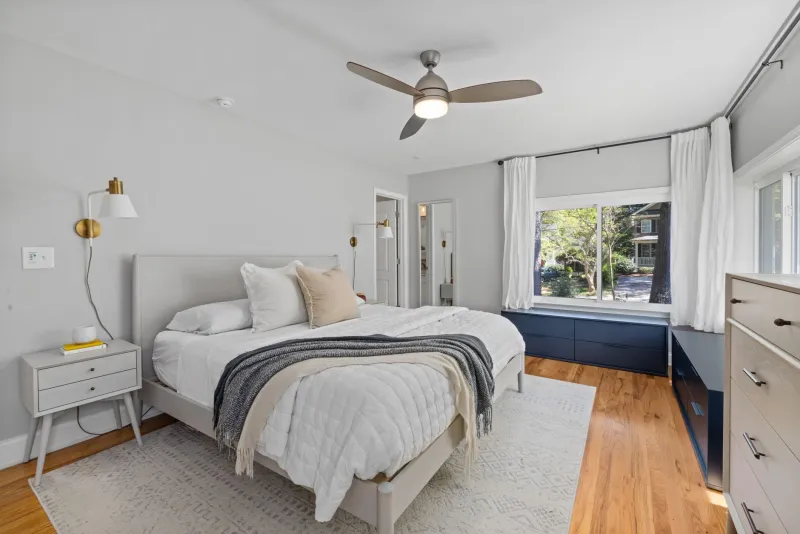
Here's a quick win that costs nothing: check which direction your ceiling fan is spinning. In summer, your fan should spin counterclockwise (when viewed from below). This pushes air straight down, creating a wind-chill effect that makes the room feel cooler without actually changing the temperature.
In winter, switch it clockwise at low speed. This pulls cool air up and pushes the warm air that's pooled near the ceiling back down into the living space — which means your furnace runs less.
There's usually a small switch on the motor housing to change direction. Takes about ten seconds.
A Few More Moves Worth Making
- Crack a window strategically. If outdoor temps drop below your indoor temp after midnight — common in many parts of the country during spring and fall — a partially open window with a box fan pulling air in can cool your room for free.
- Keep electronics out of the bedroom. TVs, gaming consoles, and charging hubs all generate ambient heat. It adds up.
- Consider a portable AC unit for extreme cases. If your central system genuinely can't keep up with a specific room, a portable or window unit for the bedroom is a cheaper fix than a full HVAC upgrade.
- Use a programmable schedule. Set your thermostat to start cooling 45 minutes before bed, then ease back up an hour before your alarm. You'll sleep better and use less energy overall.
The Bottom Line
Sleep is foundational to everything — your health, your mood, your ability to not snap at people in the grocery store. And while there's no shortage of products promising to fix it, the most effective intervention might be the least glamorous one: adjusting your thermostat, sealing your vents, hanging better curtains, and swapping your polyester sheets for something that actually breathes.
Your bedroom should be a sleep sanctuary. Getting the temperature right is the first step — and honestly, one of the easiest ones you can take.